User Presentations
U01: Patterns and Anti-patterns in APL: Escaping the Beginner's Plateau summary | slides (URL link) | video (59 mins)
Aaron Hsu, Indiana University (U.S.A.)
Writing good, efficient, maintainable APL code that maximises the value of APL's design elements does not appear to coincide with traditional best practices of software engineering commonly taught at the University level of Computer Science education. This is readily apparent in the early competency plateau that new array programmers experience after they "get the basics". While learning to write good code is the journey of a lifetime no matter what language you write in, escaping a beginner’s competency in order to really understand, manipulate, and work with advanced APL programs that exhibit all the classic qualities of "beauty" ascribed to famous APL one-liners can be better understood and facilitated by addressing the disparity between best practices in APL code and best practices as they are understood in traditional Computer Science curricula.
Understanding what makes good APL code, why this matters and how it differs from writing good code in other languages can have wide-ranging benefits. Code reviews can become more targeted, coding styles can be written in a more APL-friendly way, on-boarding beginner APL developers can be accelerated and explaining APL code to sceptical non-APLers can rely less on hand waving and appeals to nebulous, ill-defined concepts.
U02: RIDE 4.0 and 4.1 summary | slides (PDF) | video (25 mins)
Gilgamesh Athoraya, Data Analytics AB (Sweden) and Callum Floume, Optima Systems (U.K.)
RIDE 4.0 was released simultaneously with Dyalog version 16.0. Gil and Callum review the most important features of the new version, and speculate about what might be in RIDE 4.1.
U03: Working with APL for Physics Research summary | slides (PDF) | video (17 mins)
Kostas Blekos, University of Patras (Greece)
Kostas describes his experience of using APL to produce a research paper on "model making and numerical computing".
U04: APL on GPUs – A Progress Report with a Touch of Machine Learning summary | slides (PDF) | video (28 mins)
Martin Elsman, University of Copenhagen (Denmark)
(Work done in conjunction with Troels Henriksen and Cosmin E. Oancea)
Martin presents a status report of the APL→TAIL→Futhark compiler, which compiles a subset of APL into code executable on GPUs. The compiler handles quite a number of APL functions and operators and is, for the subset of APL it supports, highly compatible with code written for Dyalog APL. As well as reporting on the performance of a number of APL benchmarks, he demonstrates, by example, how the APL compiler tool chain can be used to efficiently teach a neural network to recognise handwritten digits.
U05: Co-dfns Report 2017: Ease of Use, Reliability and Features summary | slides (URL link) | video (39 mins)
Aaron Hsu, Indiana University (U.S.A.)
The Co-dfns compiler has made significant strides to improve usability, reliability and the feature completeness of the compiler – in this talk Aaron focuses on the status of feature-completeness and improvements to the installation, configuration and usage. He gives specific instruction on understanding errors and debugging issues with the compiler as well as providing a set of guidelines for writing high-performance APL code with Co-dfns, explaining how the performance model of parallel computation differs from the performance model of the interpreter when writing code. This will help anyone who is writing Co-dfns programs to understand how to optimise code to best run on the compiler.
Time permitting, a bit of flashy demo time might also be in the works!
U06: Parallel Execution in a Monolith Application summary | slides (PPTX) | video (30 mins)
Lars Villadsen, SimCorp (Denmark)
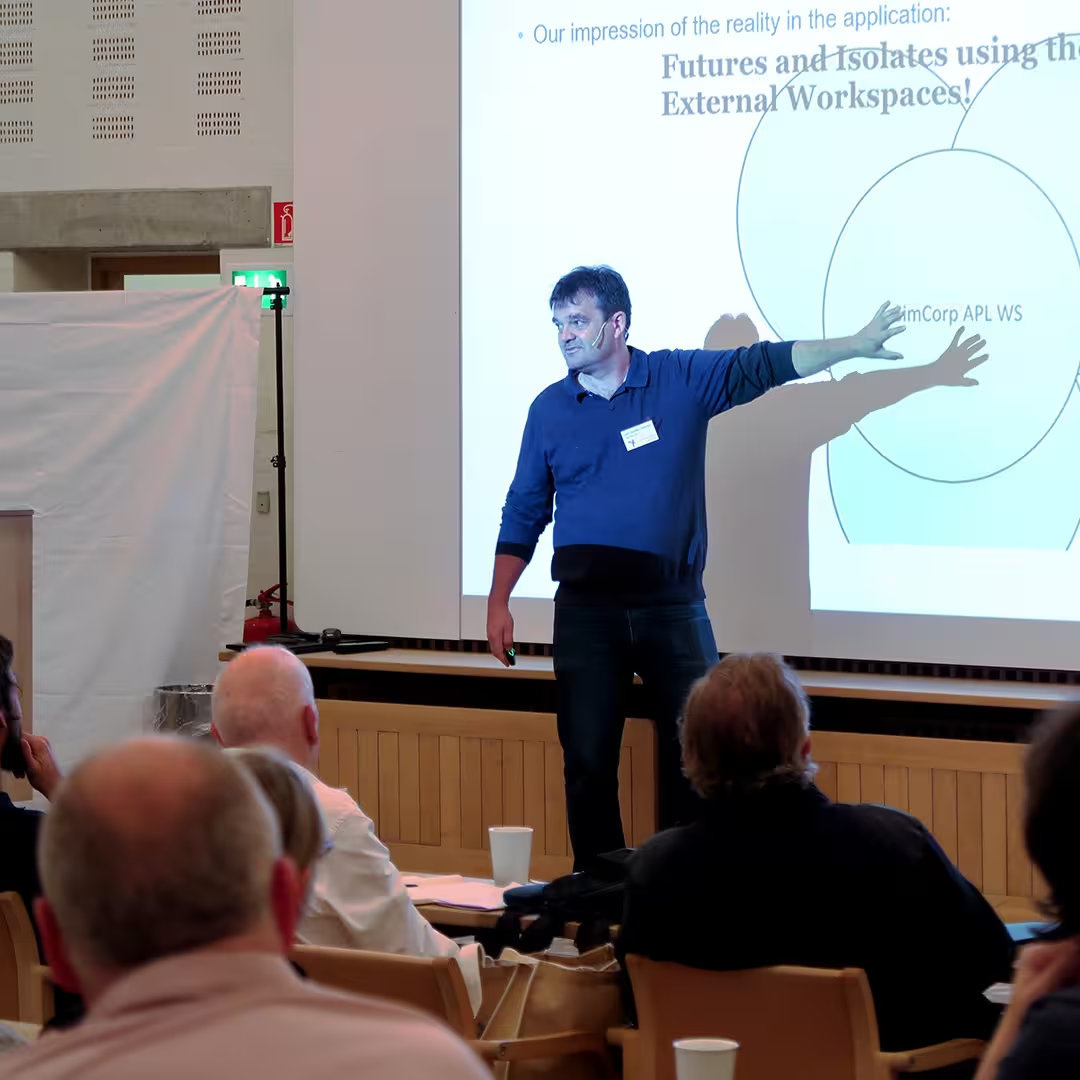
Assuming that you have all the time in the world and no customers then you would probably be able to get your application designed to run in parallel fashion with well-defined components and clear interfaces between components – but what do you do when this assumption does not hold?
Lars gives an introduction to the way in which SimCorp tries to utilise the power of the modern PC HW and use more than one CPU and still work within the boundaries set by a 25-year-old application.
U07: Freedom Hunting: Our Search for Independence in UI Design summary | slides (URL link) | video (27 mins)
Annalisa Camillo, SimCorp Italiana (Italy)
Over a few decades, our application (SOFIA) has run on different operating systems, moved from one APL interpreter to another, and experienced dramatic changes in user input/output technologies. We have worked hard to abstract our designs from hardware contexts, to free screen design from rigid bonds, and to dream up adaptive screens using a dynamic approach.
U08: APL in SA: The Joys of Financial Reporting and Creating Libraries for Everyday Use summary | slides (PPTX) | video (18 mins)
Zack Batik, RiskFlow (South Africa)
Banking in Southern Africa has a heavy focus on regulatory reporting. Reading substantial amounts of data, doing a little bucketing and some simple sums is the game. After writing three import routines in three months or manually exporting 100 .dlls in a day it becomes apparent that there must be a better way.
Having generalised tools to handle common tasks allows for more time spent on the interesting side of coding. Furthermore, having access to open source tools and libraries has become the norm for most popular languages but is not as readily available in APL. Zack discusses the motivation for, and application behind, several open source tools that he has developed.
U09: Exploring the RF spectrum with Dyalog APL summary | slides (PDF) | code (GitHub link) | video (36 mins)
Moris Zucca, SimCorp Italiana (Italy)
In the last decade, low cost devices capable of receiving raw data in a wide range of frequencies have become commonly available on the market. Software Defined Radios (SDR) are now widespread, replacing components that are traditionally implemented in hardware with software. Moris explains how it is possible to connect the Dyalog APL interpreter to those devices and to receive and convert the radio signals using APL.
U10: Managing Projects That Never End summary | slides (PDF) | video (25 mins)
Alexey Miroshnikov, InfoStroy Ltd (Russia)
For many years, we were a small team with deep insight into subjects we had worked on together for a very long time, and minimal internal communication requirements. As we added less experienced team members and the number of parallel projects grew, we realised that we needed tools to help us manage our work – but "traditional" project management tools didn't feel very comfortable.
This is the story of how Alexey discovered the JIRA framework from Atlassian and came to understand that Agile project management was exactly what he was looking for.
U11: Polyominoes in APL summary | materials (ZIP) | video (32 mins)
John Niss Hansen (Denmark)
In 2 dimensions, a polyomino is a plane geometric figure formed by joining one or more congruent squares edge to edge; in 3 dimensions, cubes are used instead of squares and joined side by side. In this talk, John discusses multi-dimensional polyominoes, and why APL is a good tool for not only enumerating and visualising polyominoes, but also for creating and solving puzzles in 0-4 dimensions, where polyominoes are used as pieces.
U12: Evolutionary Programming summary | materials (ZIP) | video (30 mins)
Gilgamesh Athoraya, Data Analytics AB (Sweden)
Nature is beautiful and complex, so it is not surprising to see so many attempts at mimicking nature when looking for a solution to a problem. Artificial neural networks have been successfully implemented to interpret images and other signals.
Evolutionary and Genetic Programming is using the principals of biological evolution to find a solution to a problem. A population of genetic code evolves through generations of reproduction and mutation until an individual is produced that is particularly fit for the problem at hand.
Gilgamesh presents a study of Evolutionary Programming using function trains as chromosomes and isolates to parallelise the evolution of the perfect train.
U13a: How I Won the APL Problem Solving Contest – Introduction and Prize Ceremony summary | slides (PDF) | video (13 mins)
Brian Becker and Carlo Spinicci, SimCorp Italiana (Italy)
The ninth annual International APL Problem Solving Competition took place earlier this year. Brian introduces the contest and grand prize winner, culminating in the award ceremony.
U13b: How I Won the APL Problem Solving Contest summary | slides (PDF) | video (11 mins)
Kostas Blekos, Panepistimion Patron (Greece)
Kostas Blekos is the grand prize winner of the ninth annual International APL Problem Solving Competition. Following the award ceremony, Kostas describes his experiences of APL/Dyalog and tells us how he managed to managed to master enough of it to win the competition.