User Presentations
U01: Dyalog APL in the Biggest Data Centres at the Heart of the Investment Management Industry summary | slides (PDF)
Oliver Lanz, SimCorp (Denmark)
Dyalog has a firm place in the heart of SimCorp Dimension, which is the backbone of more than 50% of the top investment management firms worldwide; it manages over €35 trillion combined. Oliver offers some insights into why SimCorp like Dyalog, the position it has within their architecture, and their plans for positioning it better in relation to increased demands for security and cost of ownership. He gives a high level view on the architecture of the SimCorp Dimension product, and discusses SimCorp's position on concepts such as shared code files, the .NET bridge, multi-threading, type checking, code signing, and more.
U02: Telemetry and Protobuf summary | slides – Telemetry (PPTX) | slides – Telemetry (PDF) | slides – Protobuf (PPTX) | slides – Protobuf (PDF) | video (26 mins)
Gilgamesh Athoraya, Tiamatica AB (Sweden) and Sandra Persson, Tiamatica AB (Sweden)
Monitoring your software's performance and behaviour by collecting telemetry data is nothing new. The open source project OpenTelemetry aims to standardise how this is done. Gilgamesh presents how OpenTelemetry can be used from Dyalog and demonstrates a sample application that emits telemetry data.
Telemetry data can, optionally, be emitted using Protobuf (Protocol Buffers), a mechanism for serialising structured data. Sandra presents an APL implementation of Protobuf and a plugin that generates APL code from schema files.
U03: raylib-apl – A Simple Cross-Platform Library for Graphics, Sound, Interactivity, and more summary | slides (PPTX) | slides (PDF) | demos (ZIP) | video (24 mins)
Brian Ellingsgaard, independent (Faroe Islands)
raylib-apl makes the C library raylib available to the APL programmer on all platforms. Like APL, raylib was originally used for teaching, in its case, games programming. However, raylib has expanded to include 2D, 3D, and VR graphics, with custom fonts, animated 3D models, shaders, images, textures, mathematical functions, sound, and more. It has also evolved its own vibrant ecosystem.
Brian describes how you can take advantage of this functionality, and when it is appropriate to do so.
U04: Taming Regression using APL summary | slides (PPTX) | slides (PDF) | video (28 mins)
Stephen Mansour, Misericordia University (U.S.A.)
There is a natural progression in mathematics from arithmetic to algebra to linear regression. Define a linear function f(x)=mx+b and let y=f(x). Using simple arithmetic, one can determine the y-value given x. We can use high-school algebra to find x given y. In linear regression we know both x and y; we want to find the function f. Dyalog allows us to create this function under program control using namespaces and defined operators. Stephen also demonstrates extensions to this concept including multiple and non-linear regression.
U05: Dyalog for Data Science summary | slides (PPTX) | slides (PDF) | video (19 mins)
Jesús Galán López, Ghent University (Spain)
Jesús explains how Dyalog can be used in the field of data science. He starts by solving several typical introductory problems using only the APL primitives, to prove that they offer a powerful toolset for data analysis, before exploring the use of more advanced features in Dyalog for the development of libraries. Finally, he investigates how APL is applied to the solution of real data oriented problems in the field of materials science.
U06: Climbing Trees and Catching Bugs summary | Tutorial | slides (online) | slides (PDF) | video (16 mins)
Asher Harvey-Smith, University of Warwick (U.K.)
A few brave APLers have forged a path forward for working with trees in APL, and Asher wants to bring their findings to the masses. He presents his tutorial for working with trees (represented with parent vectors), describing both its content and the tools he used to combine illustrations, APL code, and prose.
U07: APL MOOC: An APL Course for University Students summary | slides (PPTX) | slides (PDF) | video (24 mins)
Sergey Ichtchenko, University of Helsinki (Finland)
APL is not well known among the younger generation – it's time to make a change! For the past year, Sergey and his team have been developing an online APL MOOC (Massive Open Online Course) for the University of Helsinki. He demonstrates its progress, and shows the impact it can have on how we teach a new generation of APL thinkers.
U08: Planely Winning the APL Forge summary | slides (PPTX) | slides (PDF) | RIS Videos (ZIP) | Project (GitHub) | video (29 mins)
Holden Hoover, independent (Canada)
Automatic Dependent Surveillance–Broadcast (ADS-B) is an aviation surveillance technology that allows an aircraft to determine its position using GPS or other methods and continuously broadcast its position and status over a radio signal. These raw signals can be received by ground antennas and transmitted to a central server for parsing and aggregation. Holden demonstrates how he won the 2024 APL Forge with his Radar Ingest System. This APL application is designed to connect multiple antennas and feed real-time raw data from aircraft into the system, where the data is then parsed, stored, and distributed using a web API.
U09:Migrating to Dyalog from APL+Win: Workspace Transformation summary | slides: incorporated examples (PDF) | slides – separate examples (PDF) | summary paper (PDF) | related article (link) | video (24 mins)
Markos Mitsos, ERGO (Germany)
Markos describes the migration of a sheaf of APL+Win workspaces to Dyalog, a project that he has undertaken using the Link framework. "Migration" in this context encompasses restructuring into namespaces, using multiline headers, taking advantage of new primitives, and so on. He also took the opportunity to make further changes to the code, such as improving error handling and enhancing modularisation.
U10: Deployment of the Dyalog Interpreter as an OLE Server for Interactive Use (Microsoft Windows Only) summary | slides (PPTX) | slides (PDF) | Workspace (ZIP) | video (24 mins)
Jürgen Wiedemann, Dittrich und Partner Consulting (DPC) (Germany)
In connection with a migration project from APL+Win to Dyalog, DPC developed a solution for integrating the Dyalog interpreter in the form of an OLEServer object. The ActiveX server for APL+Win was the model for the solution.
The main requirement for the development of the interface was not only the pure interface to the interpreter for code execution, but also the necessity for access to the development environment in its entirety, with editors and tracer for debugging. In concrete application scenarios, the interface is used for programming and maintaining heterogeneous applications in which different code sources and development environments are used. Jürgen explains the development undertaken by DPC.
U11: Developing in Dyalog with Modern Tools summary | slides (HTML) | demos (ZIP) | video (23 mins)
Kai Jaeger, independent (Germany)
Kai demonstrates how he develops with Dyalog using the latest tools and technologies; he opens a project using Cider, investigates a bug report, fixes the issue and reduces the technical debt, produces a new version, runs tests, and publishes the updated version as a Tatin package.
This includes using tools such as Git, GitHub, Cider, and Tatin, performing a search-and-replace with ]Fire, using a comparison utility, and leveraging user commands like ]APL2Git and ]GitHub, among others.
U12: Noodle, A Cross-Platform, Object-Oriented Framework for Developing Single-User Desktop Dyalog GUI Applications summary | video (27 mins)
Pete Donnelly, Alonissos Programs Limited (U.K.)
A few years ago, Pete decided to port Filos (Greek for friend), a Greek/English Language system that he had developed for PocketAPL, to mainstream Dyalog. He chose to use the HTMLRenderer to replace the Microsoft Windows GUI, mainly for portability, and this choice forced him to learn HTML, JavaScript, and CSS. He decided to use an object-oriented approach, partly because the HTML DOM (Document Object Model) is object oriented and partly because an OO approach suited his application. At some point, he realised that he had developed the basis of a general framework that could be used to develop any type of Dyalog GUI application, and Noodle is the result.
The Microsoft Windows GUI objects (such as Button, Edit, and Grid) are replaced by HTML elements (such as Button, Input, and Table), but Noodle also supports jQuery user interface widgets, and now the commercial jQWidgets library. It provides a built-in layout tool, so users do not need to specify the position and size of GUI elements. Just as the Dyalog Windows GUI requires no knowledge of the basic Windows API, Noodle users need know nothing about HTML, CSS, or JavaScript. Despite the fact that Noodle uses the HTMLRenderer, it is NOT a web server application.
Pete demonstrates how to use the Noodle Framework to develop the GUI for an application and some of the widgets currently available before discussing future developments.
U13: PxEdit to GitHub – Refurbishing a Seasoned APL Application to Open Source summary | slides (PDF) | video (20 mins)
Veli-Matti Jantunen, Statistics Finland (Finland)
PxEdit started as a temporary application for just one specific purpose, but quickly gained lots of users. It has become an all-purpose tool for creating and managing Px files containing statistical tables, which is crucial for the many organisations around the world who are using PxWeb databases.
Over the years, the application has grown in an uncontrolled fashion, with new features added when needed, quick hacks, and fixes over patches. With an end goal of making PxEdit open source, Veli-Matti gives a short introduction to how the code, infested with almost every APL sin, might be rearranged so that another human being could understand it. Possibly.
U14: Some APL Pioneers I Knew summary | slides (PPTX) | slides (PDF) | video (23 mins)
Charles Brenner, DNA-View (U.S.A.)
When Charles graduated from university, Larry Breed invited him to join the APL group at IBM – comprising Ken Iverson et al. – in developing an APL interpreter and, to an extent, APL itself. These were inspiring people to work with, as remains the case today.
U15: Key Technical Decisions During the Development of Dyalog APL summary | presentation (PDF) | video (21 mins)
Geoff Streeter, independent (U.K.)
Geoff takes a historical walk through some of the key technical decisions made during the development of Dyalog APL. Expect some nostalgia, some repentance, some triumphalism, and some serendipity.
U16: Let's Put the Future Behind Us (Panel Discussion) summary | video (38 mins)
Host: Stephen Taylor, Lambent Technology (U.K.)
Panellists: Gitte Christensen, independent (Denmark), Pete Donnelly, Alonissos Programs Limited (U.K.), Geoff Streeter, independent (U.K.)
Decades ago we expected that by now computers would mostly talk APL, which would have taken over the world. Stephen asks Gitte, Geoff, and Pete how they took care of APL in the real world and kept the dream alive.
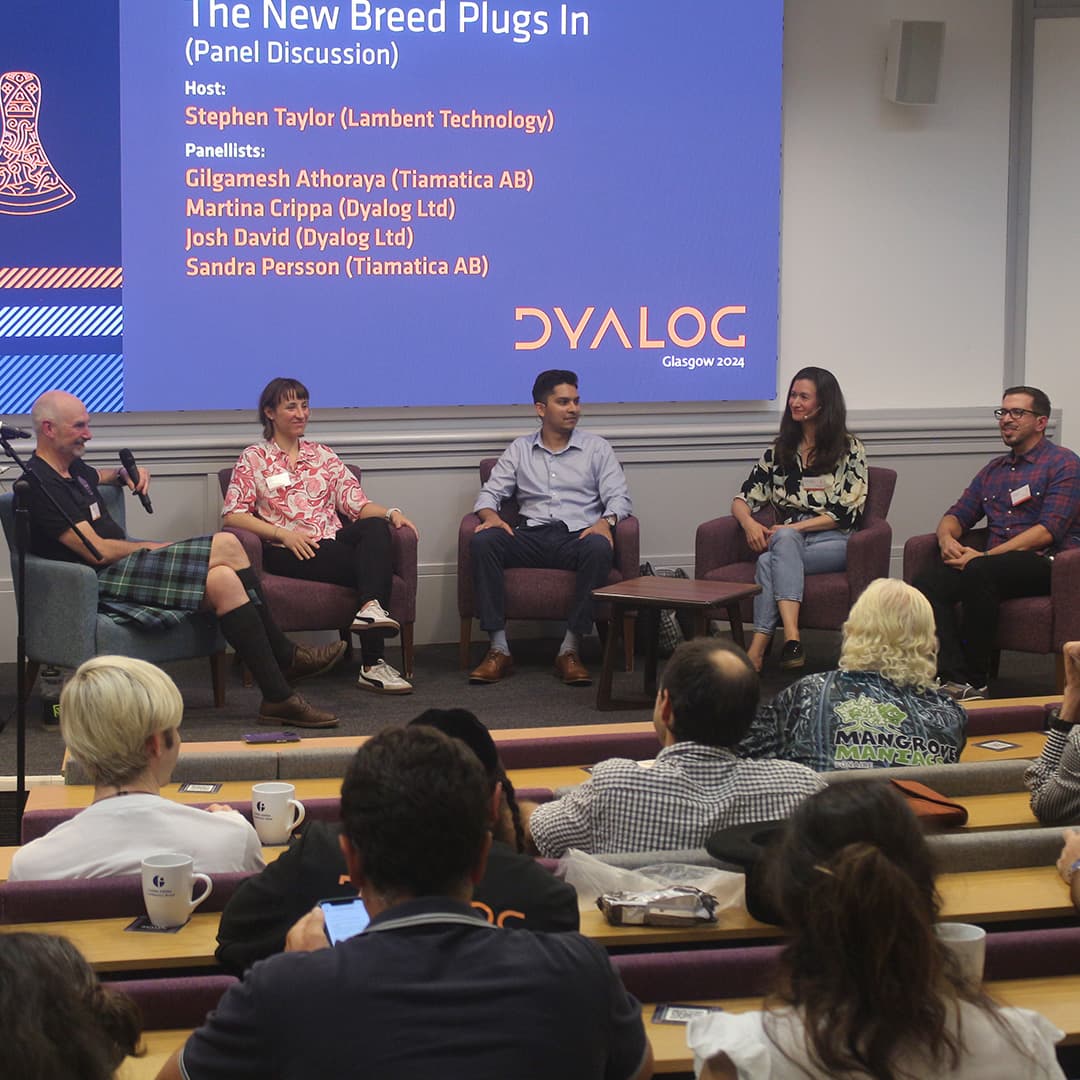
U17: The New Breed Plugs In (Panel Discussion) summary | video (35 mins)
Host: Stephen Taylor, Lambent Technology (U.K.)
Panellists: Gilgamesh Athoraya, Tiamatica AB (Sweden), Martina Crippa, Dyalog Ltd (Denmark), Josh David, Dyalog Ltd (U.S.A.), Sandra Persson, Tiamatica AB (Sweden)
For its first two decades, APL was most new users' first encounter with programming – and an exciting plunge into personal computing. These days, most new APLers know several programming languages already. Stephen asks Gilgamesh, Martina, Josh, and Sandra what APL looked like to them at first, and why they stuck with it.